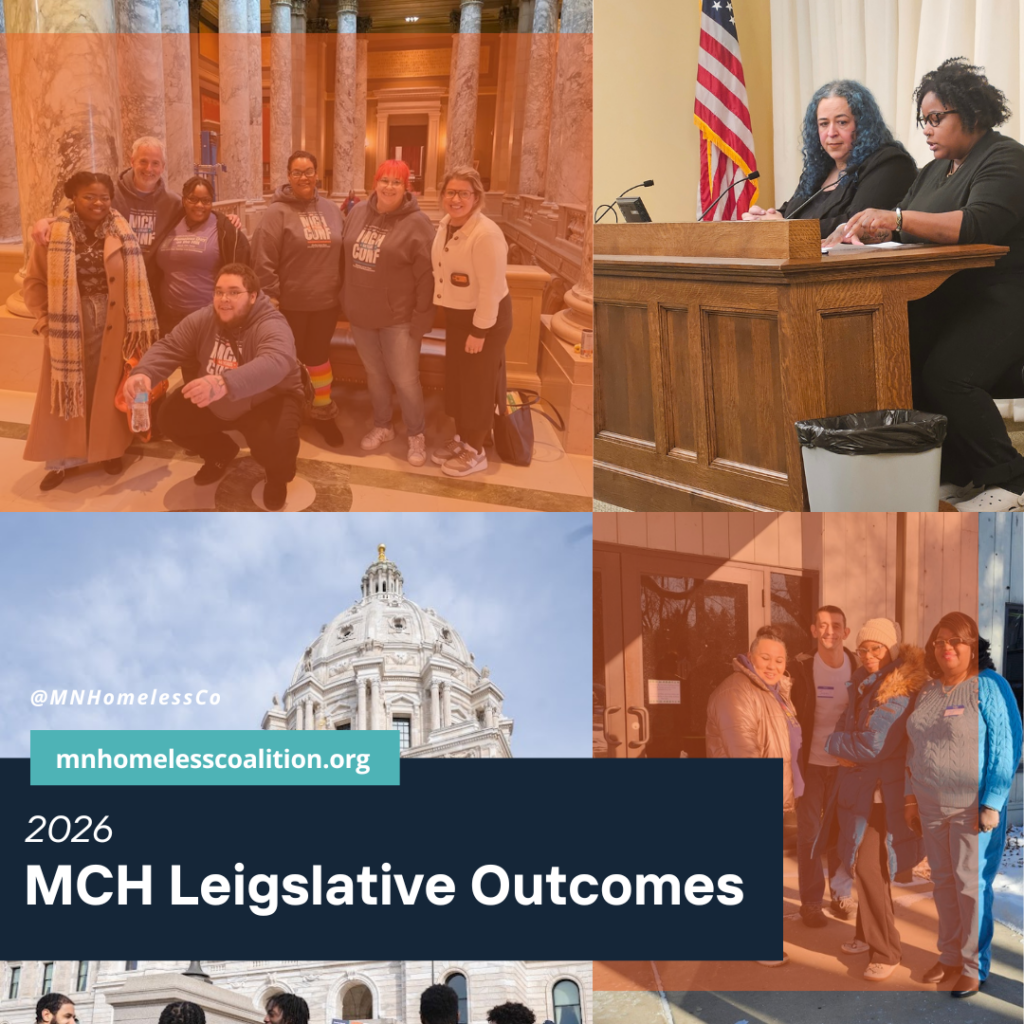
As the 2026 legislative session wraps up, we wanted to share a more comprehensive look at the progress made this year to prevent and end homelessness across Minnesota. Alongside our partners and advocates across the state, the Minnesota Coalition for the Homeless helped advance key investments and policy priorities that strengthen housing stability and support children, youth, adults, and families experiencing or at risk of homelessness.
Check out the MCH 2026 legislative priorities and outcomes below.
Family Housing Prevention and Assistance Program (FHPAP)
- 2026 OUTCOME: $40M for Family Homeless Prevention Assistance. As a reminder, FHPAP is designed to provide flexible financial assistance and supportive services to families, youth, and single adults who are homeless or at imminent risk of becoming homeless, to lead towards housing stability. FHPAP can be used for, but is not limited to, financial support, such as rental or mortgage costs, utility payments, transportation, and propane. In addition to financial assistance, it provides support services, including housing search assistance, referrals, employment resources, system navigation, and more.
- MCH Priority led by Advocacy Fellow: Vonn Grayson
Local Homeless Prevention Aid (LHPA)
- 2026 OUTCOME: The sunset for Local Homeless Prevention Aid (LHPA) was successfully extended from 2028 to 2032; a major victory for homelessness prevention efforts across Minnesota. LHPA provides flexible funding to counties and Tribal Nations to address housing instability before it escalates into homelessness, particularly for youth and families connected to school systems. Funding can be used for rental assistance, utility support, and other locally driven prevention strategies that help keep people safely housed while reducing the need for more costly emergency interventions.
- MCH Priority led by Advocacy Fellow: Ash Littles
Sustain the Gain: Supportive Housing and services to address homelessness
- 2026 OUTCOME: $13M for supportive housing and the homeless response system. Due to federal priority shifts and changes to state funding, Sustain the Gain addresses the urgent need for sustainable investments in supportive housing and services across Minnesota. Supportive Housing is the backbone of long-term stability for people with the highest needs. This funding also safeguards the emergency response, transitional services, outreach, coordinated entry, and data systems that keep communities functioning effectively. No single provider, county, Continuum of Care (CoC), or funding partner can do this alone; this investment preserves system capacity and ensures vulnerable Minnesotans remain housed.
- Priority led by MCH Advocacy Fellow: Randi Wickham
Our fourth MCH Advocacy Fellow, DaKota Morgan, was helpful in advancing the Our Future Starts at Home legislation. Check that out here.
Other legislative priorities to note
- The Housing Committee Bill invests in statewide housing affordability and stability through housing infrastructure bonds and targeted funding for workforce housing, manufactured home infrastructure, tenant and homeownership education, and innovative housing programs.
2026 OUTCOMES:
- $100 million in housing infrastructure bonds
- $14.3 million to the Greater Minnesota workforce housing;
- $4 million for manufactured home infrastructure grants;
- $425,000 for statewide tenant education and hotline services;
- $150,000 for a homeownership education program; and
- $150,000 for the Minnesota Nice Homeshare pilot program in St. Louis County, which helps match older adults who have rooms to rent to tenants.
- The Capital Investment Bill (bonding bill) funds statewide infrastructure and construction projects through state bonds and cash appropriations; below are housing infrastructure projects across Minnesota.
- 2026 OUTCOMES:
- $10M in one-time funds for Shelter Capital (GO)
- These are General Obligation (GO) Bonds, meaning a local unit of government must be the fiscal agent (legally being the owner of the land and property)
- $17.5M for Public Housing Rehabilitation (GO)
- Local projects with Capital Investment
- $8.85M for Duluth HRA Mission Engagement Center
- $5M for Hennepin County – Avivo Rehabilitation Services Facility
- $1M for The Bridge for Youth in Minneapolis
- $250K for New Pathways Inc. in Cambridge
- $10M in one-time funds for Shelter Capital (GO)
Health and Human Services (HHS) Bill
- The Health and Human Services (HHS) Bill helps with investing in public assistance programs and services across Minnesota.
- 2026 OUTCOMES:
- $10 million in one-time appropriations were awarded to food banks and food shelves for hunger relief
- $5M for food shelf grants
- $5M for Regional Food Bank grants
- $10 million in one-time appropriations were awarded to food banks and food shelves for hunger relief
- The Higher Education Bill invests in Minnesota’s colleges and universities by funding student financial aid, workforce development programs, and campus operations while expanding access and affordability for students across the state.
- 2026 OUTCOMES:
- The legislature approved a total of $2.07 million in targeted, one-time funding to shore up the Fostering Independence Higher Education Grant program.
- This includes $570,000 from the Workforce Development Fund to explicitly guarantee tuition-free coverage for eligible foster youth during the Summer 2026 term, alongside a $1.5 million General Fund investment to fully back cost-of-attendance grants (covering tuition, fees, room, and board) for the entire 2026–2027 academic year.
- Postsecondary institutions must now provide automatic priority registration (eliminating case-by-case petitions) and legally protect students who need to miss class or take a leave of absence to care for a sick child.
MAXIS and/or County and Tribal Human Services Infrastructure
- 2026 OUTCOMES: $50M for IT Modernization for MAXIS and/or County Human Services Infrastructure. This will help improve the experience for both staff and individuals seeking support.
- More context in this House Article here
Thank you to all of our partners, advocates, MCH Advocacy Fellows, lobbyists, Alumni of the Fellowship, and lawmakers who prioritized housing stability and homelessness prevention during this legislative session.